
The $795 Math Problem: Why I Built CSR-Maxxing to Calculate the True Value of the Chase Sapphire Reserve
2026-07-05
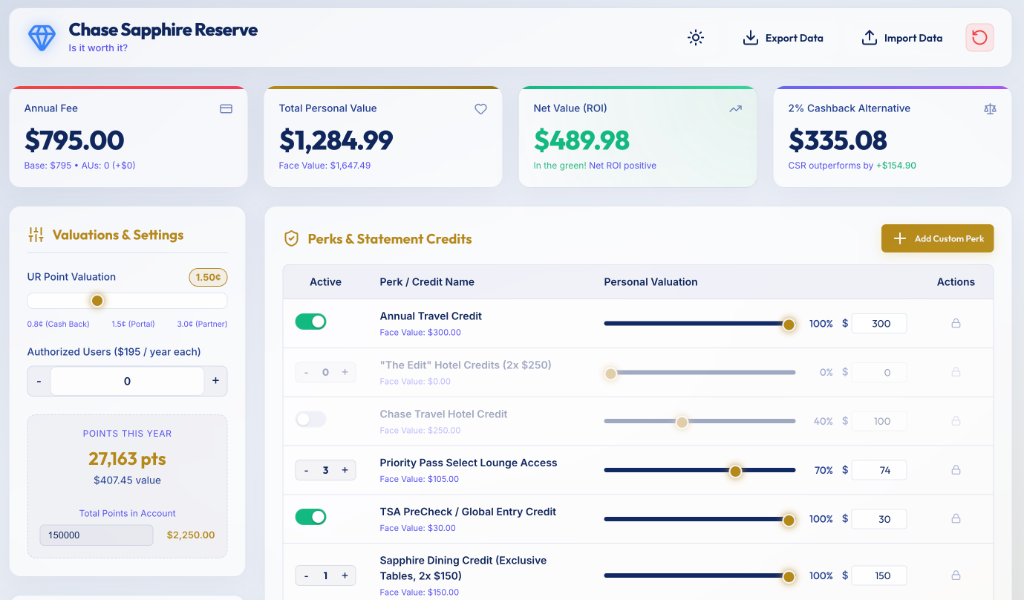
Carrying a premium travel card like the Chase Sapphire Reserve (CSR) once felt like a no-brainer. But with the annual fee recently raised to a staggering $795 (plus $195 per authorized user), carrying it requires asking a hard question: Are you actually getting $795 of value out of this card, or are you just falling victim to the "coupon book" illusion?
The "Coupon Book" vs. 2% Cash Back
To justify high annual fees, premium cards bundle perks like DoorDash credits, Lyft memberships, and lounge access. But do you actually value these at face value? If a $10 DoorDash credit forces you into inflated delivery fees, or lounge access only gets used once a year, the retail value is an illusion.
Meanwhile, alternative cards offer a flat 2% cash back with $0 annual fee—zero portals, zero fees, and zero cognitive load.
Deciding between them shouldn't rely on vibes; you need real math based on your actual transaction history. That is why I built CSR-Maxxing.
What is CSR-Maxxing?
CSR-Maxxing is an offline-first, privacy-respecting web dashboard designed to do one thing: quantify the real net ROI of the Chase Sapphire Reserve based on your personal spending habits and perk valuations.
Instead of letting credit card marketing departments tell you what their perks are worth, CSR-Maxxing lets you decide.
Here is how it works:
1. Statement Analysis Without the Privacy Cost
Most financial tools require you to link your bank accounts through third-party aggregators, giving up your personal data. CSR-Maxxing is 100% client-side. You export your raw transaction history CSV directly from Chase, and drag and drop it into the dashboard.
The parser runs entirely in your browser. None of your credit card statement data ever leaves your computer. The engine immediately:
- Tallies spending multipliers (e.g., 5x on Lyft, 8x on Chase Portal Travel, 3x on Dining, 4x on Direct Travel, and 1x on general spend).
- Auto-detects standard statement credits (such as the $300 annual travel credit).
- Scans for activated Chase Offers (e.g., WHOOP or Disney+) and adds them as statement credits.
2. Personalized Perk Valuation Sliders
Instead of assuming a perk is worth its retail face value, CSR-Maxxing lets you define its value using sliders.
- Priority Pass: Retails at $469, but if you only value lounge access at $50, you can drag the slider to $50.
- DoorDash / Lyft Credits: If you only use these services because of the credits, you can value them at a discount (e.g., 50% of face value).
- Ultimate Rewards Point Valuation: Value your Chase points at 1.0¢ (cash back), 1.5¢ (travel portal), or higher (transfer partners).
3. The Ultimate Comparison: CSR Net ROI vs. Flat 2% Cash Back
Once your statement is imported and your valuations are set, CSR-Maxxing runs a side-by-side simulation. It takes the exact same transactions you made on your CSR and calculates how much cash back you would have earned on a zero-fee 2% cash-back card.
The dashboard then shows you the raw truth: Did your CSR points and customized perk values outperform a simple cash-back card after subtracting the $795 annual fee?
Moving Beyond Financial Vibes
Building CSR-Maxxing forced me to look at credit card spending through a strictly quantitative lens. For many cardholders, importing their data reveals a surprising truth: once you discount the lifestyle perks you don't care about and subtract the high annual fee, a simple, zero-fee 2% cash-back card actually wins. For others, heavy travel and dining expenditures easily justify the premium card.
Check out the repository for CSR-Maxxing to run the calculator locally and parse your own statements.